
Interview: Wu Zhuoling on the zen of ambient music
The electronic artist on how living in Tibet and a UFO sighting changed her perspective

Hello and welcome to Concrete Avalanche, a newsletter about music from China. Thanks very much for reading.
If you’d like to listen to lots of great music from China for free, all in one place, check out the Concrete Avalanche playlists here. Please support the artists if you can.
I also have a tip jar running on Ko-fi. You can contribute here if you’d like:
In this issue: a special edition, an interview with Wu Zhuoling. Ahead of the release of her new EP, the “chameleonic pioneer at the forefront of China’s live electronic counterculture” (as her official bio puts it) talks early influences, her brush with a UFO, and why Chinese people need ambient music now more than ever.
“I strive to use sound to paint the pictures I have in my mind”
As a child, Wu Zhuoling was witness to one of China’s most famous UFO sightings. Now, she’s releasing a new space-themed EP featuring audio from NASA’s archives.
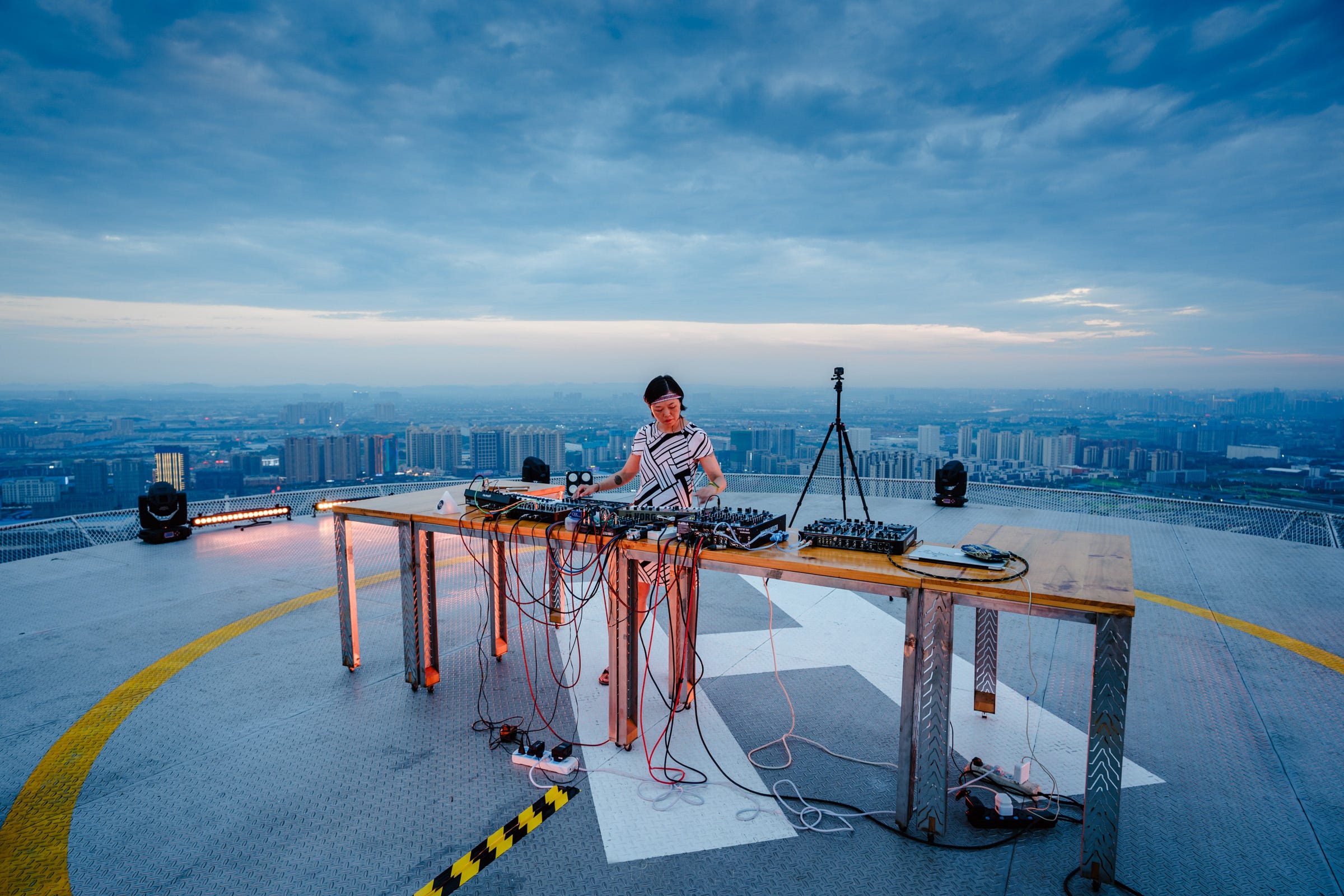
The dazzling downtempo / ambient record is a sequel of sorts to her 2023 EP Uncharted, with a special vinyl release combining the two EPs and adding remixes from Cola Ren, tp.Dutchkiss and more. It’s the latest milestone in a music-making career that over the course of two decades has seen her experiment with rock, folk, trip hop and more, tour Europe and the US, and provide support for the likes of Max Cooper and Rival Consoles. Little wonder she’s seen as a lynchpin of the Chengdu scene.
Ahead of Uncharted II’s release, Wu was kind enough to take time out from preparing for a five-city China tour (not to mention her support slot for Bonobo in a few weeks’ time) to answer my questions. Below is the full interview, in which she covers her diverse musical career, influences from Wham! to Led Zeppelin to Portishead, and her view on the future of music in China.
What are some of your earliest memories related to music? Were there any albums or artists that really captivated you, that made you truly take notice of music at a young age?
I remember hearing a piece of music on the radio when I was very young—it was melodious yet melancholic. It felt both distant and beautiful, and it left a deep impression on me. I never heard it again until one afternoon, over 30 years later, I suddenly heard someone playing it on his phone. In that moment, I stood frozen in place, feeling as though I had been transported back to my childhood. I hurried over to ask the name of the song—and it turned out to be a name so simple that seemed unreal: ‘Pastoral Song’. After searching online, I discovered it was originally a mournful folk song from the Inner Mongolian grasslands dating back to the 1920s.
[Above is a short clip of ‘Pastoral Song’, performed here by Dedema (not necessarily the version Wu is talking about here)]
Another piece from the radio that stayed with me was the ‘Dance of the Yi People’ played on the guzheng; I found the melody both strange and fascinating. By the late 1980s, when I was in primary school, Western pop music began flowing into Mainland China. I remember listening to tapes by Wham! — those songs were so catchy and full of energy that I never forgot them.
Later on, the son of a neighbor across from my building returned from Beijing and would occasionally sit on their balcony playing guitar and singing. That was the first time I heard the sound of a guitar; I was so captivated that I’d lean against the balcony railing, listening intently out of pure curiosity. These are my most vivid childhood memories of music.
Were you a dakou (“cut-out” cassette or CD) collector?
When I was in university, I could buy dakou cassettes at street stalls on campus or in record shops. I wasn’t a hardcore collector who actively hunted them down. Usually, if I happened to come across some, I’d just use my pocket money to pick up a tape or two. In the beginning, I had no idea which bands or genres to look for. The stall owners would recommend a bunch of things to me, and I’d choose the ones where the cover art looked best. I remember coming across albums by The Cranberries, The Doors and Led Zeppelin that I really loved, as well as a live recording by Dire Straits.
Later on, I bought many dakou CDs or swapped them with friends. Before MP3s came along, these were my only source of information on international music. Unfortunately, after moving house countless times, almost none of my original tapes or CDs have survived.
You grew up in Chengdu, but have also lived in Beijing and Lhasa. Can you talk a little about how each of these places has influenced you and your music?
It was in Chengdu that I learned instruments like the guitar, bass, and drums; I started joining bands and writing my own songs. Back then, I didn’t have much financial pressure—life was easygoing, though it lacked a certain challenge. In 2000, I moved to Beijing, because at that time, anyone in China playing in a band was heading there. Beijing taught me so much and helped me grow; I lived in the famous ‘rock village’ of Shucun [树村, an area of Beijing where rock musicians from across the country congregated and lived in the early ’00s], but I also worked a white-collar job in the CBD. I met many fellow musicians and gained a real understanding of the music industry. I formed a new band, Wednesday’s Trip, performed at music festivals, signed with a record label, and released our first album.
However, after four years, I grew completely weary of the frantic pace of big city life, which felt directionless and meaningless. I wanted to go somewhere remote and exotic, and fate led me to Lhasa. During my two-plus years in Tibet, I hardly touched music at all. I started as a tourist but gradually integrated into the local way of life. Lhasa showed me aspects of the real world that exist far beyond the bubble of rock music and the arts; it deeply reshaped my worldview and my values. During my final period living in Lhasa, I wrote many simple, soulful folk songs.
What drew you back to Chengdu?
Chengdu is my hometown, and there is nowhere else where I feel more comfortable. Additionally, the cost of living in Chengdu is relatively low; making music or taking on some part-time work is enough to support myself. Chengdu has also always had a great musical atmosphere—in China, it is second only to Beijing and Shanghai. There are many independent bands and live performances, making it very suitable for musical creation. Therefore, returning to settle in Chengdu was the best choice for me.
Can you talk a little about how you first got into playing music? How did you first get involved in bands and the scene around Little Bar, the renowned Chengdu gig spot?
Right at the start of my freshman year of university, I saw the various campus clubs recruiting new members. As soon as I saw the Guitar Association, I signed up immediately because I loved the sound of guitar and was eager to learn. My family actually had a very old guitar that my brother used to play, so I went home, dug it out, and started practicing. About three months later, I had learned enough to represent the association in a university talent show. I think I performed a cover of a 罗大佑 [Taiwanese pop singer Luo Ta-yu] song.
At that time, there happened to be a rock band at my university. I tracked down their rehearsal space and told them I wanted to be in a band and play the drums. They were pleasantly surprised because it was rare to find a girl interested in drumming, so they let me practice on their kit. A few months later, I had more or less learned the basics, so I formed a band with three other students. We played covers of acts like Cui Jian, Black Panther, and Beyond.
One day while we were rehearsing, a young man with a camera slung over his shoulder showed up. He took a lot of photos of us and mentioned that he knew many other bands in Chengdu. He told us about a bar that was a lot of fun and offered to take us there. So, one day I went—it was a place called ‘Little Bar’ (小酒馆), right next to my middle school. I started going there regularly to watch bands playing shows, and before long, I became a regular part of the Chengdu rock scene.
How did Wednesday’s Trip come together? There weren’t many artists in China making trip-hop-influenced music back then…
In 2000, I went to Beijing and lived in Shucun with other rock musicians. I told my friends there that I wanted to start a band. After some recommendations and advice, I quickly found a drummer and a guitarist, and recruited a bassist from the band Sound Fragments 声音碎片. We gave the band a very artsy name: “Wednesday’s Trip.” As the guitarist and lead singer, I was responsible for creating the melodic motifs and lyrics, and then the band would work together to finalize the structure and rehearse the details.
Back then, we listened to a lot of foreign music to learn from and draw inspirations. One day, I happened to hear Massive Attack, and that’s when I first learned about trip hop. I went on to listen to other albums by Massive Attack, Portishead, and Tricky, and I genuinely loved them. Plus, the style suited my voice perfectly, so I decided the band would make trip hop/dream pop music.
Was there a specific moment when you became more interested in electronic music and, specifically, in creating your own productions?
Shortly after I first moved to Beijing, a friend installed FruityLoops on my computer and gave me a rough idea of how to use it, but at the time, I had no interest in making music with a computer. A few years later, I happened to open the software again and decided to see what I could do with it. I tried to use it to recreate a Wednesday’s Trip song called ‘Magic Hours.’ What I made was very simple, but it actually sounded quite good. Later, I used FruityLoops to play around with a more experimental little track. Both of those pieces eventually ended up on Wednesday’s Trip’s first album, Secret Mission.
In 2007, I installed Ableton Live on my laptop. My original intention was to use it to record some of the folk songs I had written in Lhasa, but I soon discovered it was much better suited for electronic music. In 2009, I used Ableton Live to produce an EP called ‘Can This Erase The Distance?’ (是否这就能消除掉距离), which combined Singer-songwriter songs with electronic music.
By 2013, I had essentially stopped using the guitar and was composing entirely with software; my interest in electronic music was only growing stronger. By 2016, as Wednesday’s Trip had fewer performances and activities, I shifted almost completely toward my solo projects.
Is there a common thread that you feel has connected your approach or your sound from those early days—from your folk and trip hop music to your current productions?
There might be one common thread running through everything: I love using music to tell stories, many of which are imaginary. Even though the music I make now has no lyrics, I still strive to use sound to paint the pictures I have in my mind. Another commonality might be that I’ve always preferred beautiful, somewhat melancholic melodies, and I find myself naturally gravitating toward rhythmically driven genres like trip hop.
Today, you only use hardware for your live sets. Where does that preference come from?
Yes, I feel like performing with a laptop doesn’t feel like a real performance. Also, back when I used to perform with a laptop and an audio interface, I’d run into issues like the interface dropping out or the software freezing up (that was many years ago—it’s unlikely to happen with the laptops nowadays), so I felt that approach wasn’t as stable as hardware. Ever since I built a complete performance setup using hardware, I’ve been creating almost entirely on hardware instruments, so I no longer use laptops or software during performances.
It’s been three years since Uncharted. What made you want to return to the themes you explored on that first EP for this new record?
Actually, at first I didn’t intend to continue the story of Uncharted. The main inspiration for Uncharted II came from a game I was deeply immersed in in the winter of 2024/25: Outer Wilds. For a long time, I was absorbed in the game’s atmosphere and storyline. Around that time, I also started playing a new instrument, Elektron Syntakt, and was trying to integrate it into my live setup. I composed a new track primarily using Syntakt. One of its sounds resembled a radio signal, which reminded me of the story in Outer Wilds, so I titled it ‘The Signal’.
Perhaps by coincidence or subconsciously, the three tracks I created afterward all aligned with the theme of space exploration. I thought these four tracks could form a new EP, but I couldn’t settle on a title. Then last summer, it occurred to me that I could release this new EP together with the original Uncharted—which never had a physical release—as a double LP. I realized these four new stories actually bridged perfectly with the original Uncharted narrative, serving as a sequel of sorts. And that’s how it became Uncharted II.
Reverie, the album you released after Uncharted in 2024, also featured several tracks that seemed inspired by outer space and the stars. What is it about space that inspires you to create music about it?
It’s because I saw a UFO when I was a child. My family, many neighbors, and I all witnessed a spiral-shaped flash in the night sky, about the size of the moon, slowly rotating as it flew away and then vanished. You can still find news reports about it today—the 1981 spiral UFO sighting in western China. That event had a profound impact on me, and ever since then, I’ve been fascinated by space and mysterious phenomena.
For the first Uncharted, the introduction noted that “The Zen philosophy of classical poetry and painting and contemporary ambient music share the same vision with different perspectives.” Are these historical references also a key part of your work on this new record?
What I meant is that both appreciating classical poetry and painting and listening to ambient electronic music can evoke a sense of Zen. In 2023, when I was choosing a title for that EP, a line of ancient poetry suddenly popped into my head: ‘Deep in the clouds, their whereabouts unknown’ (云深不知处). It happened to be the exact imagery I had in mind while creating that music. To keep with the classical theme I chose part of the Tang Dynasty painting “Emperor Xuanzong’s Journey to Shu” (明皇幸蜀图) as the cover artwork for the EP.
I think pairing a very modern style of music with classical poetry and traditional landscape painting is quite interesting; it creates an unexpected contrast. But at their core, these art forms share the same aesthetic and point toward the same Zen philosophy—they just differ in form and medium.
Can you talk a little about your process for making new music?
I don’t have a fixed method, but I usually start with a single sound element and develop it freely. Sometimes it’s a synth pad, sometimes I set the tempo first and program a drum kit, and sometimes it’s a chord loop. Then I build on these foundations by adding other sounds—it feels like I’m jamming with myself. Once all the parts are in place, I arrange the overall structure of the piece. Most of this is done on my usual hardware setup, though if needed, I’ll use software to create additional elements or incorporate interesting sound samples.
When I used to compose on a computer, my sole focus was on producing a polished final work. Now, when I compose on hardware instruments, I’ll also consider how to perform it live with my usual gear—and sometimes I even compose tracks specifically for certain settings, such as a club dance floor, an outdoor ambient music event, or a concert with art installations in a museum.
On Uncharted II, you incorporate audio clips from the NASA archive. What led you to using those recordings?
If I only used music to tell a story about space exploration, I was worried it might be too abstract for the audience to follow the narrative I was trying to depict. But with some vocal samples, listeners are naturally drawn into the scene, as if they were listening to a sci-fi movie soundtrack. So I searched for authentic recordings related to spaceflight and exploration, which led me to NASA’s public archives.
I mainly looked for conversations between mission control staff or astronauts, selecting the clearest and most representative clips. I recall that many of these recordings likely originated from the Apollo moon landing missions decades ago. The voices and tones coming through those walkie-talkies were incredibly warm and evoked a distinct sense of nostalgia—very similar to the vibe of the game Outer Wilds. I was deeply moved when I heard those recordings, which carried such historical significance. Every time I hear those samples in the music, I feel like the music becomes even more vivid and alive.
I should add that the sample in the track ‘Warp’ comes from a film about warp drive created by Columbia University’s Cool Worlds Lab. This is because the story I wanted to tell in ‘Warp’ is also about the dilemmas humans face when researching warp drive.
You have a number of remixes on the full album, including Cola Ren returning the favor after your remix of ‘Mekong Ballad’. How did these collaborations come about?
Cola Ren is a new-generation female producer I really admire; her work has inspired me, so we came up with this mutual remix project. Spencer, aka tp.Dutchkiss, is a producer based in LA. We were introduced through a mutual friend, and last spring, when he and two other artists from the Leaving Records label came to Chengdu for a tour, we performed together. In June, when I toured California, he also invited me to perform with him in LA. I really admire his talent, so I asked him to do a remix. It turned out absolutely amazing—way beyond my expectations.
For the Uncharted EP, I reached out to Frank Vigroux, an experimental music artist who toured with me in China and France last year; the track he chose, ‘The Watch Tower’, fits his personal style perfectly. Another remix, for ‘Neptune Rings’, comes from Howhigh, a mentor and close friend of mine who lives in Chengdu. A long time ago, he worked as a sound engineer for Wednesday’s Trip at a music festival, and a few years back, he mastered several of my very popular singles.
I try to seek out people from different cultural backgrounds and musical styles to create remixes—it makes things much more interesting.
A few years ago, you said in an interview that, “Ambient music is what China needs most right now [...] because most people here are very restless. It’s hard for people to calm down, face their inner selves, and quietly reflect on things.” Does that still apply today do you think?
That is still the case today; in fact, it feels even more restless. People are now addicted to short videos every day, and their patience lasts less than a minute. However, I feel that the live scene for ambient music is actually developing quite well. Perhaps it’s precisely because daily life is so frantic that people feel the need to occasionally switch gears—to just space out, clear their heads, and rest.
Related:

You’ve played in bands, made electronic music, performed at shows and festivals all over the country, and lived in multiple different places… this is kind of a big question, but how do you feel about where music in China is at the moment? Do you feel optimistic about where it’s headed?
In China today, music is still essentially a secondary consumer product. Most people have no real demand for it, and even when they do, they are completely indifferent to quality—it often feels as though the audience just needs a layer of constant, noisy background sound.
Regarding musical aesthetics and demand, a clear polarization has emerged in China, and the gap is only widening. While there are more people with great taste than before, there are even more who have poor taste or simply don’t care. Now, with the help of computer software and AI, the barrier to entry for music production has dropped significantly, but this has also allowed works lacking in soul or aesthetic value to flood the market. High-quality niche music struggles to break into the mainstream, while the music that achieves commercial success is often uninspired.
To be honest, I am not optimistic about the future of music development in China.
Wu Zhuoling’s Uncharted II is out digitally on March 27th. The vinyl release, with the addition of the tracks from the first Uncharted EP plus four special remixes, is due for release the following day.
There’s a special release event taking place in Chengdu on March 28th, before Wu begins her China tour with fellow Chinese electronic music stalwart SHAO in Shanghai on March 29th.
For details on all of the above, check out the official 小计划SmallProjects account on WeChat. International orders for the vinyl will hopefully be available next month.
I also highly recommend spending some time with Wu’s solo back catalogue, which is available on Bandcamp.
And if you’re still reading this and happen to be a venue booker in Europe, Wu is currently lining up some dates for a European tour this summer and is open to adding more. Find her on socials or drop me a line and I can put you in touch.
please come to london Wu !
Thanks for this! I’m enjoying the new release. Will be in Beijing the next couple of weeks but doubt I’ll be lucky enough to get to any shows - but who knows!